
Overview
Location
Québec, Canada (Otish Mountain Sedimentary Basin)
Ownership
100% IsoEnergy
Deposit Type
Uraninite-veins within a broader alteration envelope and with significant uranium mineralization at the unconformity
Highlights
- High-Grade and Substantial Historic Resources
- The Matoush Fault Zone, the structure that controls the mineralization, has been identified over a strike length extending 11km southward and 2.5km northward beyond the historic resource area. In addition, many of the zones of mineralization within the historic Mineral Resource are open alog strike and down plunge.
- Quebec ranks highly as a mining jurisdiction and has seen significant past expenditures on uranium exploration by both major and junior mining companies.
Historical Mineral Resource Estimate:
| Category | Tonnes (M) | Grade (% U3O8) |
Contained (M lbs) |
|---|---|---|---|
| Indicated | 0.6 | 0.954 | 12.3 |
| Inferred | 1.7 | 0.442 | 16.4 |
Notes:
1. CIM definitions were followed for the Historic Estimate.
2. The Historic Estimate was estimated at a cut-off grade of 0.1% U3O8.
3. The Historic Estimate was estimated using an average long-term uranium price of US$75 per pound.
4. A minimum mining width of 1.5 m was used.
5. The MT34A lens is within both the MT-34 and AM-15 zones.
6. Numbers may not add due to rounding
For additional information regarding the Matoush Project, please refer to the Technical Report entitled “Technical Report on the Mineral Resource Update for the Matoush Project, Central Québec, Canada” dated February 12, 2012, prepared by Roscoe Postle Associates Inc. (“RPA”). The Mineral Resource estimate was further updated by RPA in December 2012, as disclosed in a press release of Strateco dated December 7, 2012.
The historical estimate is reported using the categories of mineral resources and mineral reserves as defined by the Canadian Institute CIM Definition Standards for Mineral Reserves, and mineral reserves at that time, and these “historical estimates” are not considered by IsoEnergy to be current. The reliability of the historical estimate is considered reasonable, but a Qualified Person has not done sufficient work to classify the historical estimate as a current mineral resource, and IsoEnergy is not treating the historical estimate as a current mineral resource. The historical information provides an indication of the exploration potential of the properties but may not be representative of expected results. An exploration program would need to be conducted, including twinning of historical drill holes, in order to verify the Matoush historical estimate as a current mineral resource.
Geology
Mineralization at Matoush is similar to Athabasca unconformity type uranium deposits with regard to its occurrence in Proterozoic sedimentary rocks exhibiting similar alteration styles and structural controls. A notable divergence in the nature deposit at Matoush from the typical Athabasca style deposit is the lack of uranium mineralization at the actual unconformity. Uranium mineralization at Matoush occurs primarily in relatively flat lying accumulations between 150m and 600m above the basement unconformity within Indicator Formation Sandstones where they are breeched by structures. The penetrating structures have acted as conduits for the flow of mineralizing fluids and are often themselves associated with more steeply dipping zones of mineralization. It should be noted that mineralization is consistent with and roughly the same age as the Westmoreland Uranium project located in Queensland Australia.
The Matoush uranium mineralization occurs within a much broader alteration envelope and is characterized by replacement style disseminations and clots of fine-grained uraninite plus, in the higher-grade areas, semi-massive veins of uraninite.
Exploration Potential
We see significant exploration potential across a range of critical minerals, as well as base and precious metals, supported by the region's favourable geology and strong mineral endowment. Our approach to advancing these opportunities begins with relationships.
Over the past four years, we have prioritized meaningful engagement with tallymen, community members, and leadership to ensure open dialogue, transparency, and collaboration throughout our activities. We are equally committed to creating local economic benefits, with a strong focus on local hiring and procurement that supports community capacity and long-term participation in project development.
As we continue to evaluate exploration opportunities, our goal is to advance responsible resource development that is guided by respect, partnership, and shared value.
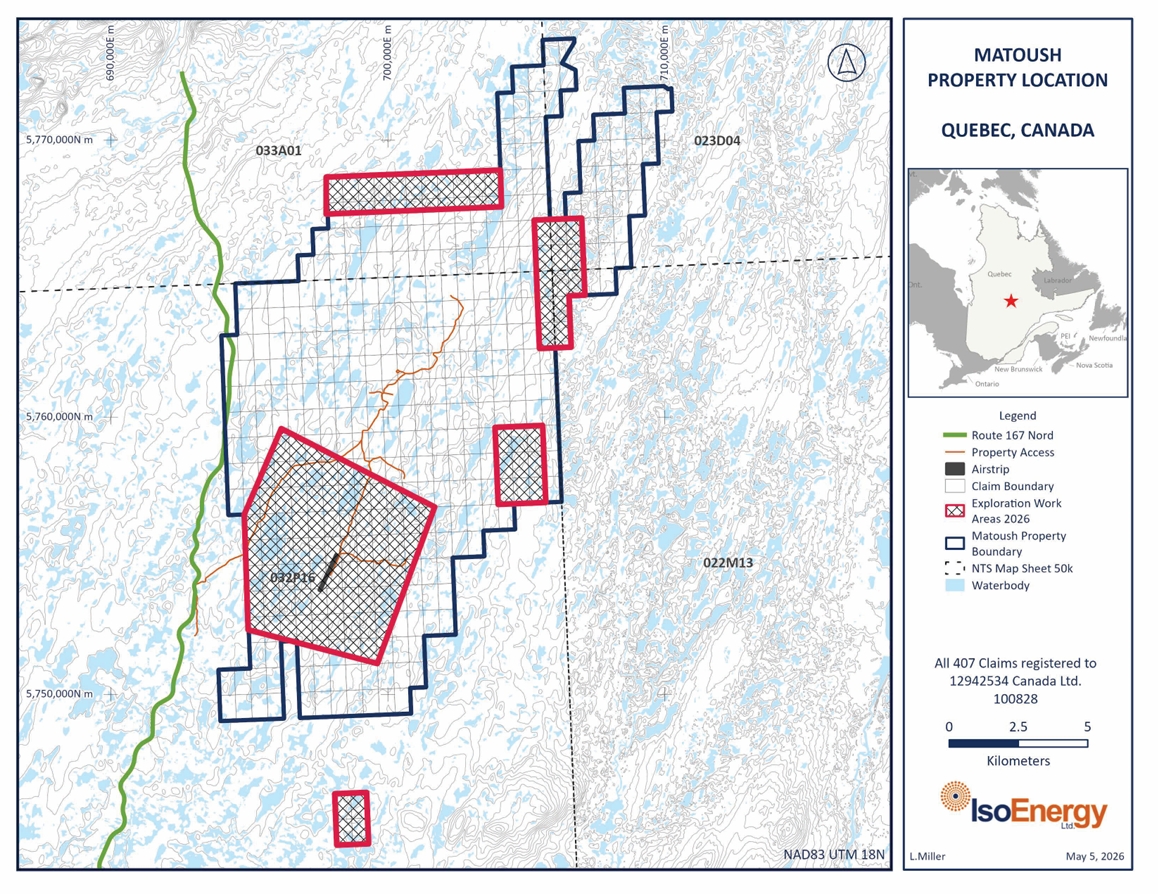
Exploration Annual Planning 2026 and the Information Session Summary.
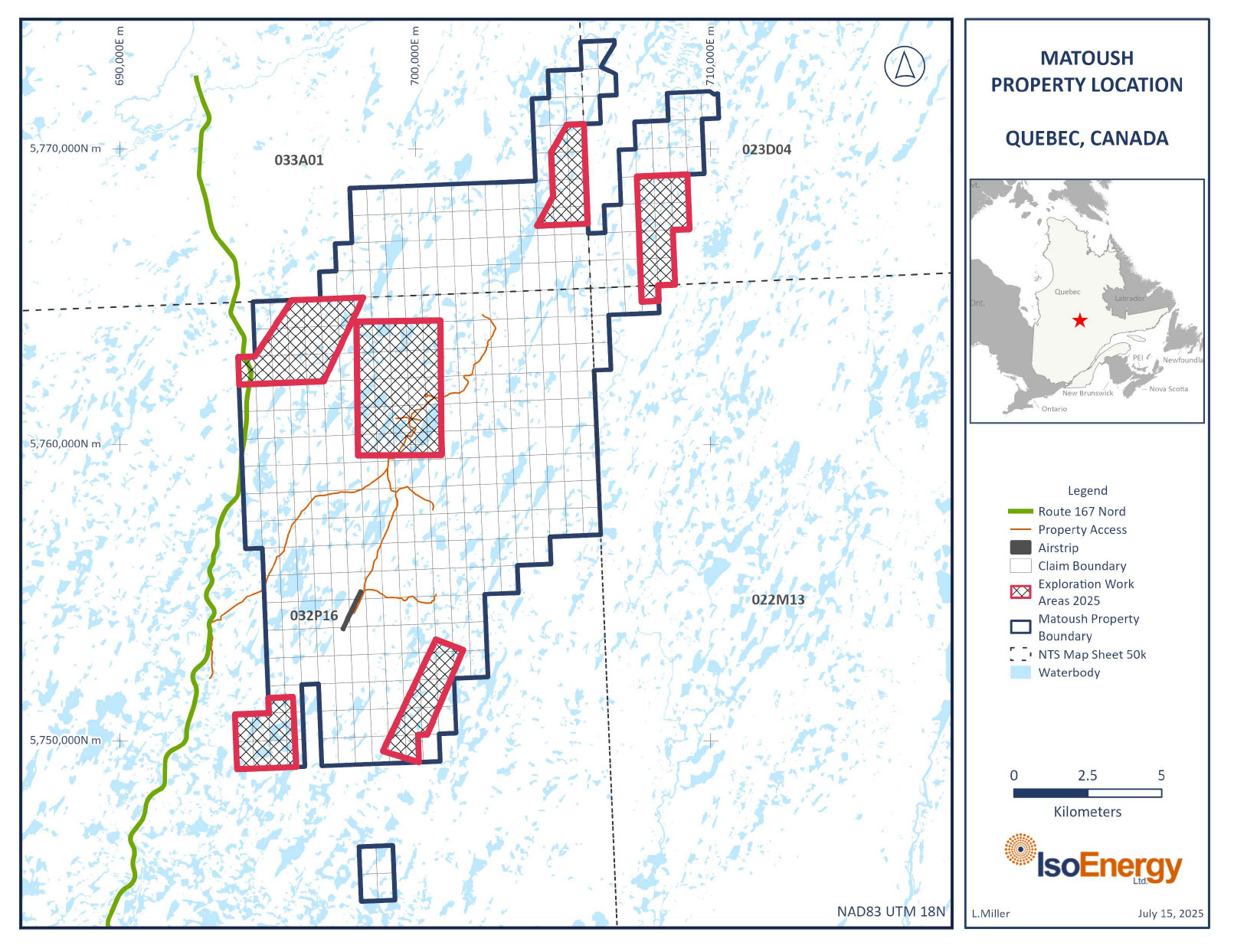
Exploration Annual Planning 2025 and the Information Session Summary.
Technical Maps
Planned work in 2026 at the Matoush project in Quebec
Planned work in 2025 at the Matoush project in Quebec
Previous Work
The Matoush project has seen extensive exploration, evaluation and permitting activities. Such activities have included the construction of a 50-person camp, a landing strip for planes carrying material and passengers and three megadomes and offices. Additionally, approx. 245k meters of drilling was completed in 591 holes. Structures previously installed by a past operator have been removed. Drill cores remain stored on-site in core racks and sea cans, alongside a few small wooden buildings historically used for core logging and sampling. Several technical and environmental studies were completed by the past operator. In 2008, an initial Preliminary Economic Assessment (PEA) was conducted, which was subsequently updated in 2010. Multiple mineral resource estimates have been completed, with the latest being conducted in December 2012. Numerous environmental studies have been conducted, making up an Environmental Impact Statement (EIS).
