
Overview
Location
Eastern Athabasca Basin, Saskatchewan, Canada
Ownership
100% IsoEnergy
Deposit Type
Uconformity sandstone hosted uranium
Stage
Exploration
Primary Minerals
Uranium
Highlights
- Comprises one claim totaling 5,961 hectares and is located 37 kilometres west of the Larocque East property which hosts the Hurricane zone
- Multiple highly prospective targets across 15-km strike being advanced with drilling and geophysics
- Drilling indicates the vertical depth to the unconformity is 600 to 700 metres
- Drilling intersected brittle structures associated with unconformity offset, alteration, and elevated radioactivity
- ANT survey identified large velocity low anomaly located 850 m along trend to the north
Geology
The Hawk project lies along a major northeast trending fault zone that crosses the Athabasca Basin. The basement geology of the project area is dominated by northeast trending graphitic bearing meta-sediments bounded by granitic rocks the the east and west.
Exploration Potential
The residual prospectivity of the Hawk project is considered very high as there are over 15 kms of a conductive corridor spatially associated with the regional northeast trending fault zone that is known to host uranium mineralization. Historically the area has seen very little exploration and represents a new frontier as exploration in the basin moves westward.
To date IsoEnergy has confirmed that the key characteristics of the Athabasca style uranium mineral system exist within the claim block:
1) hydrothermal clay alteration in the sandstone cover and basement rocks;
2) radioactivity at the unconformity;
3) brittle fault structures and
4) conductive metasedimentary rocks in the basement.
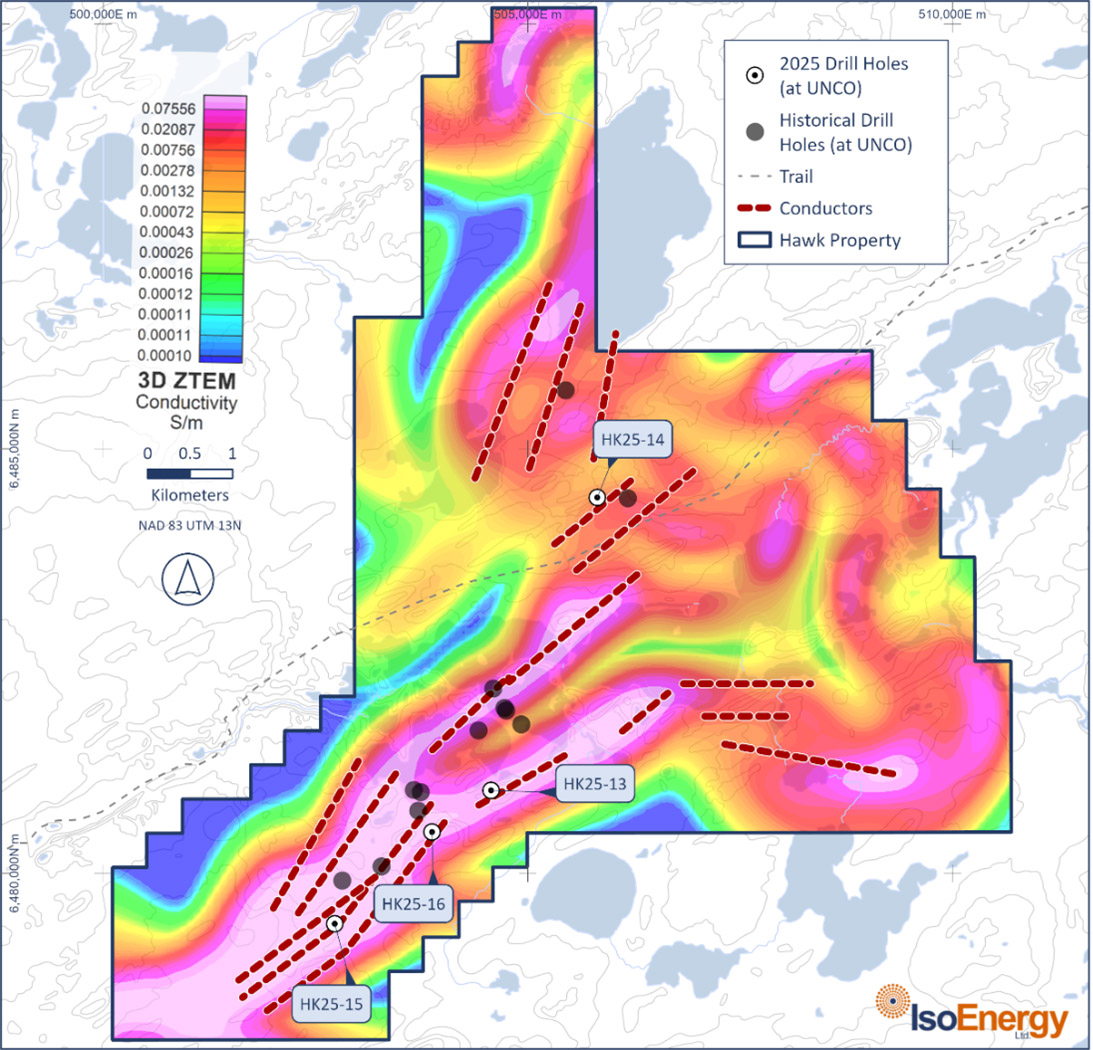
Drilling at Hawk in 2025 totaled 3,593m in four holes, intersecting graphitic basement lithologies, alteration zones, and prospective unconformities consistent with Athabasca style uranium mineralization. While no high-grade uranium intersections have been reported to date, these results reinforce the prospectivity of the project and support the potential for further exploration.
Previous geophysical and structural studies, including identification of the conductive corridor and brittle fault zones, remain relevant in assessing Hawk’s potential to host a large uranium deposit.
Technical Maps
Compilation map of Hawk project showing labeled 2025 drill hole locations, unlabeled previous drill hole locations (both at the unconformity), and interpreted ground electromagnetic survey conductors, on a plan view of the 20xx ZTEM conductivity model 50 metres below the unconformity.
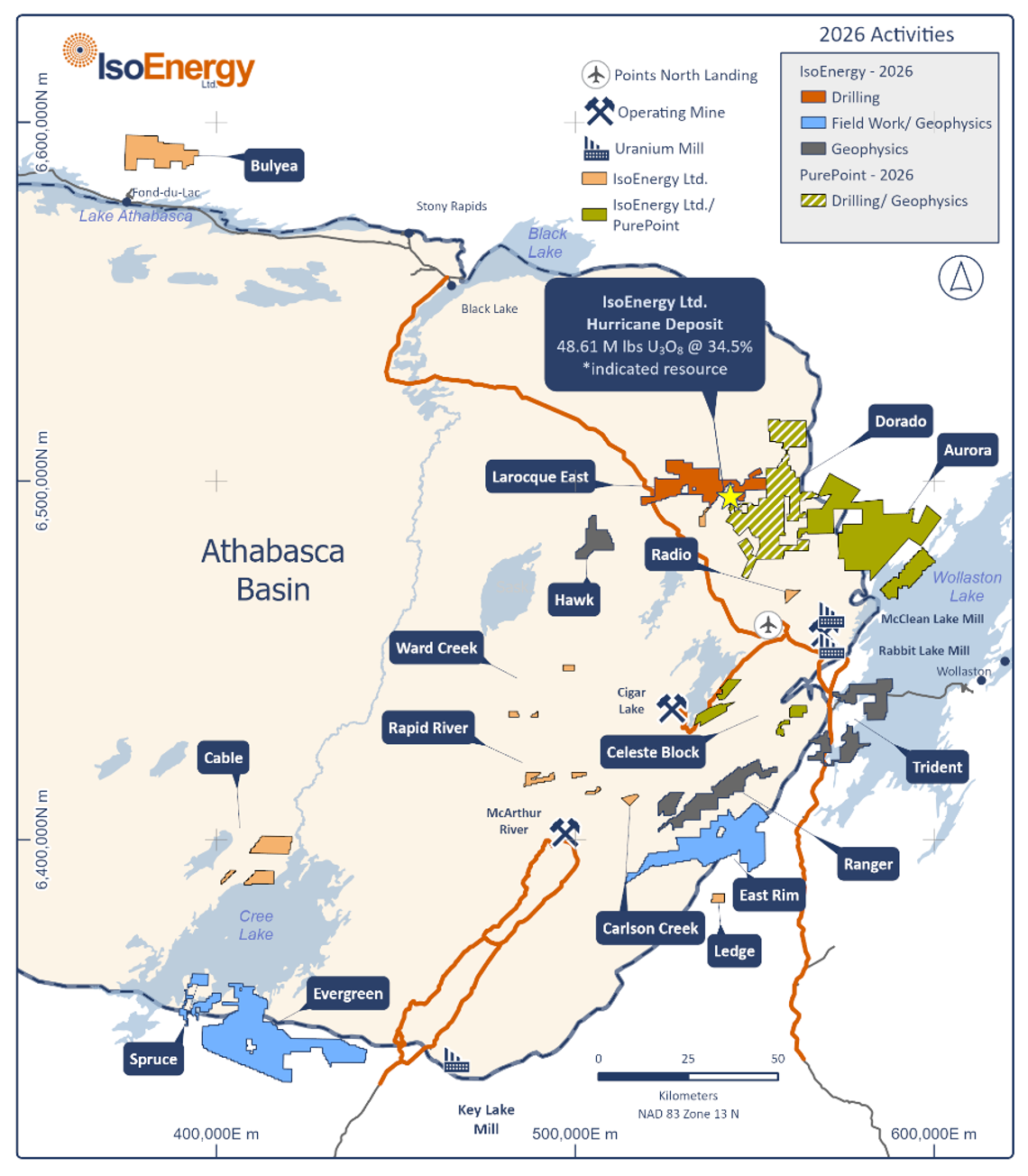
Location of IsoEnergy’s exploration projects in the eastern Athabasca Basin, highlighting projects on which work is planned in 2026.

